From the Field to Development: How Senegalese Football Icons Are Driving the National Economy
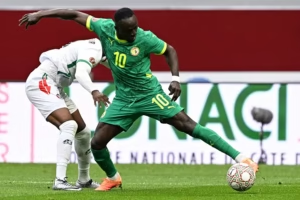
For decades, the international success of Senegalese footballers was measured solely by the trophies they won, the lucrative contracts they signed in major European leagues, and their individual accolades. Today, a new, much deeper and more enduring narrative is unfolding. Led by iconic figures of the golden generation such as Sadio Mané, Kalidou Koulibaly, and other key players of the Lions of Teranga, football stars are transitioning from mother sporting heroes to seasoned institutional investors. They are now actively and strategically investing their wealth in the economy of their homeland.
Rather than limiting themselves to traditional philanthropy or one-off donations—although such charitable actions remain essential—these athletes are now targeting critical economic sectors. By addressing infrastructure gaps and stimulating long-term structural growth, they are transforming the Senegalese entrepreneurial landscape and fostering sustainable national development.
1. Digital Infrastructure and Telecommunications: Connecting the Senegal of Tomorrow
One of the major pillars of this economic transition is undoubtedly technology. Aware that digital connectivity is the backbone of any modern economy and a catalyst for financial inclusion, several national team players have chosen to support large-scale initiatives aimed at modernizing telecommunications infrastructure.
These investments are not limited to the purchase of equipment, but are geared towards the co-financing of structuring projects:
- Expanding access to broadband: Funding the deployment of fiber optics and next-generation network technologies in peripheral and secondary regions of Senegal, thereby reducing the digital divide between Dakar and the interior of the country.
- Network reliability and accessibility: Partnerships with technology players to optimize the quality of existing infrastructures, guaranteeing stable connectivity essential for local businesses.
- Democratizing costs: By increasing infrastructure capacity, these initiatives indirectly contribute to lowering internet data costs, making digital services accessible to the budgets of ordinary citizens and micro-enterprises.
2. Boosting the Tech Ecosystem and Innovation through Venture Capital
Beyond physical infrastructure, Senegalese athletes are increasingly establishing themselves as key players in venture capital . The tech startup scene in Senegal is booming, driven by a creative youth but often hampered by a lack of funding in the early stages of development.
By injecting private capital into incubation structures or directly into the capital of startups, players are targeting key sectors:
- Fintech and Financial Inclusion: Supporting local payment and money transfer platforms, facilitating transactions for unbanked populations.
- Agritech: Funding for digital solutions applied to agriculture (crop management, water resource optimization, smart distribution chains) to strengthen the country’s food security.
- E-commerce and Logistics: Support for companies that modernize distribution channels and facilitate intercity and regional trade.
By providing this essential seed funding and growth capital, players are not simply seeking a return on investment; they are directly supporting local innovators, creating highly skilled jobs and enabling national talent to deploy their solutions regionally and continentally.
3. Strengthening the Health System: Sustainable and Structuring Investments
The global health crisis has highlighted the vulnerabilities of healthcare systems worldwide, and Senegal is no exception. In response to this, the leaders of the national team have decided to take decisive action by directly funding the construction and modernization of key healthcare infrastructure.
These projects, conducted in close collaboration with health authorities and industry experts, result in:
- The construction of state-of-the-art medical facilities: Erection of regional hospitals, modern maternity wards and specialized clinics capable of handling complex pathologies without patients having to undergo costly medical evacuations abroad.
- The introduction of state-of-the-art medical equipment: Equipping health centers with medical imaging devices (MRI, scanners), modern operating rooms and advanced biomedical analysis laboratories.
- Improving access to local healthcare: Particular emphasis is placed on the decentralization of care, with the establishment of equipped medical facilities in rural and semi-urban areas, thus guaranteeing an overall improvement in health standards for all segments of the population.
4. Institutional Real Estate Development and Responsible Urban Planning
Faced with the population explosion and rapid urbanization of the capital, Dakar, as well as new urban centers like Diamniadio, the demand for quality real estate infrastructure has become enormous. Senegalese football stars have seized this opportunity to diversify their portfolios while actively participating in the modernization of the urban landscape.
By partnering with major architectural firms and renowned property developers, they participate in the financing of large-scale projects:
- Affordable housing complexes: Development of sustainable and accessible residential programs for the Senegalese middle class, contributing to resolving the housing crisis.
- Modern shopping centers and business parks: Creation of integrated business and retail spaces, offering prime showcases for local and international companies.
- Logistics infrastructure: Financing of modern warehouses and storage areas on the outskirts of major roads to facilitate the transport of goods.
These massive investments are not only reshaping the landscape of Senegalese cities, but are also acting as a powerful economic engine. They are giving a massive boost to the construction sector, stimulating local crafts, and generating thousands of direct and indirect jobs for the local workforce.
Conclusion: A Patriotic Investment Model for Africa
By making this remarkable transition from elite athletes to institutional investors, the players of the Senegalese national team are paving the way for a new model of economic patriotism. Through their long-term vision, they demonstrate that international success can and must become a driver of local transformation. By investing in technology, healthcare, innovation, and real estate, the Lions of Teranga are no longer just scoring goals on the pitches of Europe or the World Cup: they are securing Senegal’s economic and social future.